

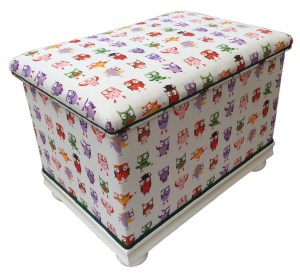
Based on the same design as other Ottomans, this rather smaller box was covered in a bright fabric with an undercover suited suitable for items used by babies and children. A soft close hinge was also incorporated.
The six sides for the box were cut out, with a 6mm wide and deep groove around the top of the sides and all around the lid.
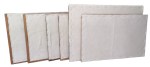
The box was temporarily dry assembled. Once in pieces again, the insides of all six panels were covered with woolsafe. Generally the pieces were fitted to the edge of the panel but cut back where another panel would fit on top.
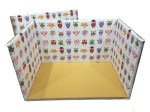
Cover fabric was secured over the woolsafe. The fixing places were chosen so that they would be hidden. For the base it was secured on the edges of the board. For edges with a groove, it was secured at the bottom of the groove. For all the rest it was either secured near to or around the edge.
The base was now assembled, using the screw holes made during the earlier dry assembly.
The top of the lid will be usable as a seat. A 19mm paper roll was stapled to the edge and a 1” piece of rubberised hair cut to just fit inside.
Over this a layer a felt was added going right to the edge.
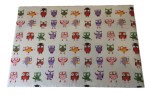
Wool safe was secured over the top, fixed just to the side of the groove.
Cover fabric was stretched over the top, fixed at the bottom of the groove.
Four bun feet were drilled for dowels with matching holes drilled in the base. Wood trim was added around the base of the box. Both the trim and feet were given several coats of paint.
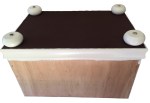
An undercover was fixed in place and the four positions for the bun feet cut out.
The bun feet were glued and hammered into position. Domes of silence were added to the centre of each foot.

The box was covered on the outside with woolguard, secured at the bottom close to the wood trim, on both sides of each corner and to the side of the groove on top.
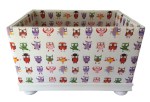
Lengths of fabric were pinned to the outside, fabric face to the inside. They were marked on the two corners where they met and the two pieces sewn together to form a continuous length.
This was turned the right way out and pulled down around the outside making sure the seams were straight and on the corners.
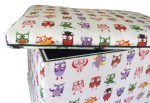
Piping was glued into the grooves around the top and the lid.
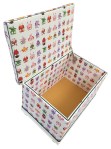
The lid was secured with two hinges. One, a length of piano hinge along the back edge, the second, a soft close hinge on one side.
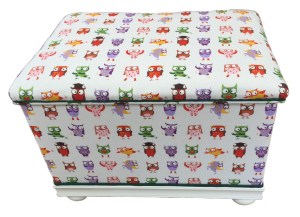
To complete the project, double piping was added to the top of the wood trim, the joint placed out of sight on the back and covered in a strip of fabric.
Time to fill with goodies and take a seat!
You may be interested in other Storage Options which can be found in the Soft Furnishings section.
JBerryUpholstery has many examples of furniture Recovering and Restoration and also Soft Furnishings to add to or complement the finished items. You can see pictures of these in the Galleries – Recovering Gallery, Restoration Gallery, Soft Furnishings Gallery and Transformations.
If you have some upholstery that is in need of a bit of TLC or you are interested in Soft Furnishings then please contact us.
 J Berry Upholstery