
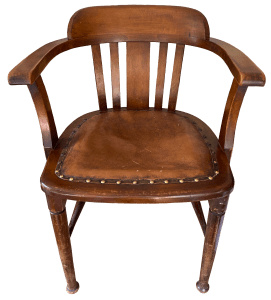
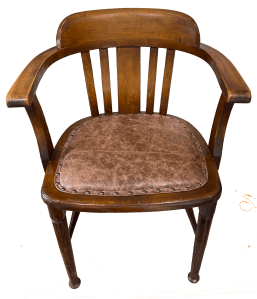
This apparently sturdily made office chair had a leather seat which had a serious sag!
The chair seat needed a complete replacement and a new leather cover. The back also needed repairs.
With the chair in the workshop, it was clear that the five back pieces were all loose! They had come loose from one end or the other. Fortunately, the additional movement of the back had not impacted the joints at the front of the arms.
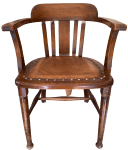
With the joints open, as much as possible of the old glue was removed, new glue added and the back cramped in place and set aside to cure.
With the chair repaired, the decorative nails were extracted and the ‘leather’ cover was removed. On the underside was written “Rexine Brand”.
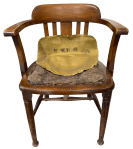
A quick search tells us that:
The British Leather Cloth Manufacturing Company was incorporated as a limited company in 1899. The name “Rexine” was officially listed as a brand by them in the 1915 Trademarks Journal.
The original Rexine material was a type of artificial leather made by coating a cloth fabric (such as cotton) with a mixture of cellulose nitrate, camphor oil, pigments, and alcohol to give it a leather-like appearance and texture. This affordable faux leather was widely used for upholstery, bookbinding, and the interiors of vehicles throughout the 20th century.
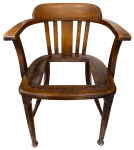
The old underlying stuffings, support cloth and webbing was removed.
The opportunity was taken to add a little stain and polish to areas of woodwork that had suffered superficial damage over the years.
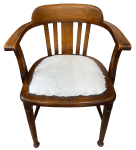
New webbing, support cloth and stuffings were added and topped with barrier cloth.
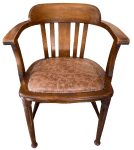
New, real, leather was added over the seat.
The final task was to add a leather strip around the edge – formed from strips of leather, with folded over sides, glued and pressed.
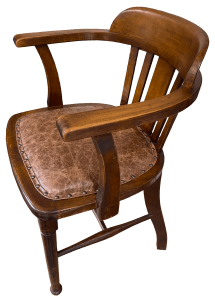
These strips were held in place with decorative nails, evenly spaced. To hide the joins, the last end piece was cut off with the next piece butted against it and hidden with a nail head over the join.
And that completed this project.
JBerryUpholstery has many examples of furniture Recovering and Restoration and also Soft Furnishings to add to or complement the finished items. You can see pictures of these in the Galleries – Recovering Gallery, Restoration Gallery, Soft Furnishings Gallery and Transformations.
If you have some upholstery that is in need of a bit of TLC or you are interested in Soft Furnishings then please contact us.
 J Berry Upholstery