

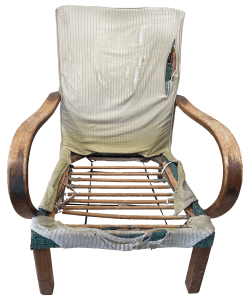
This Parker Knoll Armchair was in need of restoration. The chair was a PK708 – a bentwood oak art deco chair dated from around 1940.
While the period elegance remained, a lot else didn’t! The restoration included replacement springs and spring supports, a new back pad, new seat cushion, repairs to the frame and refurbishments of the polish work.

The loose cover over the back and around the seat frame was removed.

The green cover at the back was removed. The lower springs had fallen off and the stuffings of the front cover had decayed.
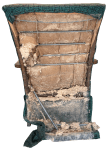
The cover fabric of the back was removed.

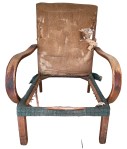
The seat springs had lost their tension. Their attachment had failed and some ingenious work with garden wire poked through holes drilled in the frame had done a good job of support. All of this needed replacement.


The remaining fabric, stuffings and springs were all removed to leave the bare frame.
With the frame clear, the history of the chair was discovered.

All of the seat sides were clearly marked as Parker Knoll PK708. On the top of the back was a label – a frame ticket – that had been stained when the chair was first covered. The date was 25.08.48 – the last digit was unfortunately partially missing but the remnant appeared to be the top part of an 8.
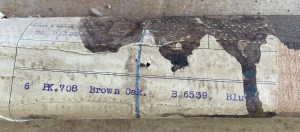
The colour was also mentioned as ‘blue’. It would seem likely that the green fabric was a later cover.
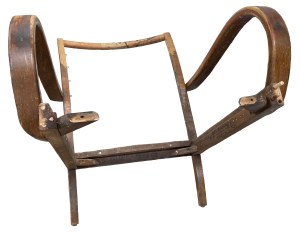
As the fabric was removed from the front of the frame, it became clear that there was a problem with the front legs which were not secure.
They were knocked free, joints cleaned, the old dowels drilled out and new ones glued in and the frame clamped.
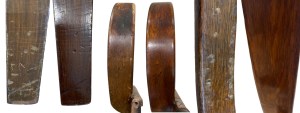
With the frame remade, the polish work was tidied up. Legs had been knocked and scratched, the tops of the arms had lost their polish and colour entirely and there was condensation damage under the arms. All the show wood was rubbed down, stained to colour match, French polished and finished with wax polish and elbow grease.
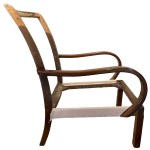
With the frame repaired and polished, the upholstery work could be started.
The first step was to cover the chair sides.
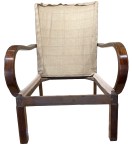
The inner back then had a hessian support sheet added.
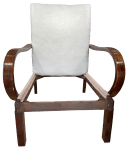
This was covered in felt – the original had been wool felt too – and covered in a woolguard cover as a barrier cloth.
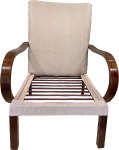
The new spring brackets were put in place and new springs pulled into place.
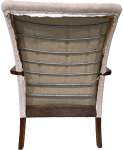
The front of the chair frame was covered and new fabric was added to the inner back.
New anchors were put in the back and the original springs pulled into place.
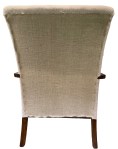
The back had a support cloth added, covered with a barrier cloth.

The back was edged with piping before the new cover was slip stitched into place, stapled under the frame.
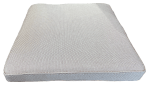
To finish the project, just a new cushion was needed.

The new cushion was made using a foam pad which was covered in wadding and stockinette. The new cover was a piped, zipped, box cover.
Placing the cushion on the chair completed the project and the chair was returned to it’s owner.
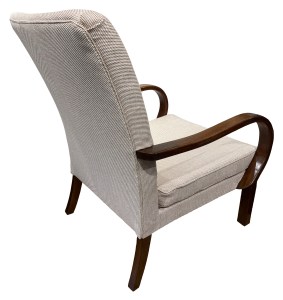
This was a fairly dramatic restoration. The chair that was returned was all new except for the frame and a few springs.
JBerryUpholstery has many examples of furniture Recovering and Restoration and also Soft Furnishings to add to or complement the finished items. You can see pictures of these in the Galleries – Recovering Gallery, Restoration Gallery, Soft Furnishings Gallery and Transformations.
If you have some upholstery that is in need of a bit of TLC or you are interested in Soft Furnishings then please contact us.
 J Berry Upholstery