


Each sofa had two seat and two back cushions with fixed upholstery over the frame. Making the new covers was done first and then recovering the bases.

The back cushions were tackled first. The fabric pieces were cut out and the gusset was made up with piping on both sides except for the zip section.
The second cover piece was attached to the other side of the gusset using registration notches to align the two faces.
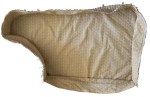
The seat cushion covers were made similarly. There were a few differences – in particular, the zip extended a few inches up the sides.
All covers were then made up and put to one side.
The worn cover was removed, noting where fixings were made, measuring the size and shapes of fabric. There was a lot of hand stitching – mostly to be avoided this time around.
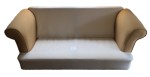
The arms were tackled first. The inner and outer arm sections were sewn together, then piping was added to their front edges. The arm front was sewn on – the fabric join of the inner and outer sections positioned in the crook of the arm front.
The completed section was pulled over the arm, cut in at top and bottom of the back, pulled tight and anchored to the frame to ensure all fixings were not visible.
The seat and inner back pieces both had sections of a secondary fabric sewn on as insufficient cover fabric was available.
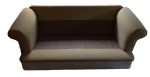
The seat, then the back were fixed in place. Inside the frame, the staples were added over the arm fabric. Outside, at the front and back, the staples were added where they would be hidden.
The skirt was made up of four pieces of fabric. They were joined with a double folded edge added along the bottom side. The 5m piece was folded, with box pleats at the sides and centre concealing the joins. Piping was then added along the top edge.
The skirt was stapled on with back tack strip defining the line of the piping. The ends were trimmed and stapled behind the back.
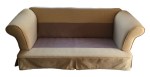

The outside back was covered with the secondary fabric. Back tack strip was used along the top, the bottom edge stapled on out of sight under the frame.
The only hand stitching of the project was used to finish the sides, running around the roll of the arms as it went.
The cushion pads were slipped into the new covers and, with the sofa upright, the cushions were put in place.
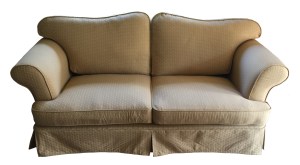
All that was needed now was to repeat the entire process for the second sofa!
Project complete.
JBerryUpholstery has many examples of furniture Recovering and Restoration and also Soft Furnishings to add to or complement the finished items. You can see pictures of these in the Galleries– Recovering Gallery, Restoration Gallery, Soft Furnishings Gallery and Transformations.
If you have some upholstery that is in need of a bit of TLC or you are interested in Soft Furnishings then please contact us.
 J Berry Upholstery