

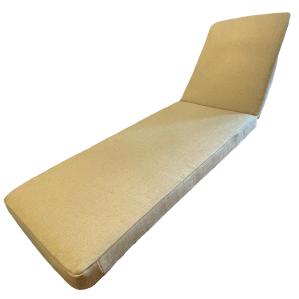
A pair of sunbed cushions needed new covers to be ready for the summer.

The two pads were joined at a ‘hinge’, allowing a single top piece of fabric. Nice idea but the consequences of this construction resulted in an interesting ‘twist’ to complete the project.
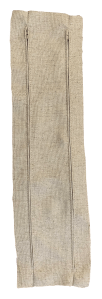
The cushions were measured, their construction confirmed and the pads removed – rather destructive as the old zips had welded themselves closed.
The three pieces for the zip section were machine sewn together at their ends, with the central parts of the two seams basted. Over length zips were placed behind the basted sections, sewn around and the long ends cut off.
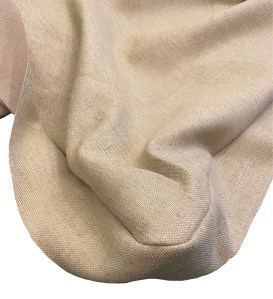
The bottom pieces of the covers were placed on the long top piece and the corners shaped on a 5cm radius. Matching marks were made on the pieces at all corners and the centre where the two bottom pieces overlapped – where the hinge will be.
Gusset sections were made up and sewn around the edge of the large top piece of fabric.
This single gusset needs to be divided in two with the zipped section completing the cushion cover sides.
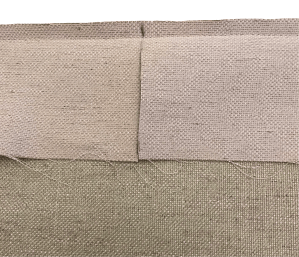
The marks on the top indicating the position of the join between the two cushions – the ‘hinge’ – were extended across the gusset. The gusset was cut on the line to within 1cm of the seam.

The cut edges were pulled back and opened up to 180 degrees and the zip section sewn onto them.

The other end of the zip section was attached to the opposite gusset in the same manner.
The cushion top has now been divided into two sections with a gusset around both.
The two cushion bottoms were then sewn to each of the gussets, lining up the marks at the corners.
With the covers finished, all the raw fabric edges were overlocked to prevent fraying.
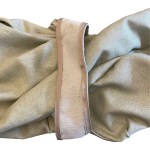
As usual for box cushion covers, the two zips were pulled apart and both covers turned right side out.
However, in this case, the dividing zip section remained on the wrong side. To sort this out, one of the covers was pushed under the zip section. This is the ‘twist’ – an interesting topological challenge!
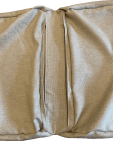
With the zips closed again and the covers laid flat, a line of stitching was run across the covers, equally spaced between the zips. This formed the ‘hinge’ between the two cushions. The covers were ready for the pads.
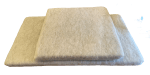
The cushion pads were covered in polyester wadding and then stockinette. The stockinette eased the task of getting the pads into the covers.

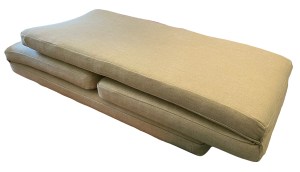
The pads were pushed into the covers to complete the project and the two sunbed cushions were delivered to their owner.
JBerryUpholstery has many examples of furniture Recovering and Restoration and also Soft Furnishings to add to or complement the finished items. You can see pictures of these in the Galleries– Recovering Gallery, Restoration Gallery, Soft Furnishings Gallery and Transformations.
If you have some upholstery that is in need of a bit of TLC or you are interested in Soft Furnishings then please contact us.
 J Berry Upholstery