

The Boat Bed was a collection of twelve foam filled cushions that fitted together like a jigsaw to form a bed. The many cushion covers were made in several different ways to allow for the differing sizes and, in some cases, quite radical shaping. All were made without piping and with zips hidden away at the back of the cushions.
Some were made with just a single piece of fabric, some had ends added separately and some had gussets added.
Single piece covers
Covers for the smaller, rectangular, straight sided cushions, were made from a single piece of fabric. The length was calculated to wrap entirely around the pad with the zip along the back. The width was the width of the foam plus the depth. Allowances for seams and the visible width of zip were included.
A piece of zip – a few inches longer than the fabric width – was added to the two edges forming a tube with the good faces inwards.
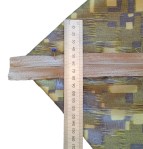
With the zip at one side and the fabric folded flat, the two open sides were sewn closed.
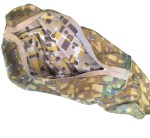
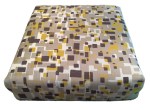
To box the cover, all four corners were pulled out, seam or zip central, sewn and cut off on the diagonal. To pull in the corners and ensure the fabric would stay taut even if it gave a little over time, the length of the sewing line was kept an inch (2.5cm) less than the foam was thick.
The zips on the covers were pulled apart, the covers inverted and the pads inserted.
Adding ends
The pads for the two back cushions were very wide, the length close to the width of the fabric, and so separate ends were needed.
The fabric was cut to wrap around the pad plus zip as before. The width though was the length of the pad plus seam allowance.

Ends were cut out the same size of the ends of the pad. They were attached so that the zip would run centrally along the lower edge.
Once inverted the pads were inserted.
A further two cushions fitted against the curving sides of the boat. While generally rectangular, one end of each needed shaping. Templates were made up and the foam shaped to fit the curved end of each – mirror images.
The cover was made up as if the pad was not shaped but with just one end boxed as for the single piece covers above.
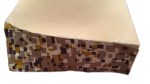
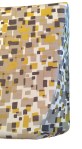
The other end of the fabric was cut following the shaping, again using the template.
Another piece of fabric was laid against the shaped end of the foam and cut out for both cushions. It was attached as for the seat backs and the pads inserted.
Adding gussets

Three of the cushions had quite extreme shaping and had to be treated in a rather different way.
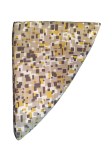
Fabric was cut out for the different top and bottom faces. Another piece was cut for the vertical sides. Two pieces with zip added centrally were made, curved to fit. One cover required a fourth piece to go around a pipe.

The various collections were sewn together to make the gussets. First the bottom and then the tops were precisely pinned to the gussets and sewn on.

With the covers inverted and zips pulled apart the final pads could be inserted.
The huge pile was then delivered to be placed in the boat. Rest comfortably!
These show the endless possibilities available.
JBerryUpholstery has many examples of furniture Recovering and Restoration and also Soft Furnishings to add to or complement the finished items. You can see pictures of these in the Galleries – Recovering Gallery, Restoration Gallery, Soft Furnishings Gallery and Transformations.
If you have some upholstery that is in need of a bit of TLC or you are interested in Soft Furnishings then please contact us.
 J Berry Upholstery